

Introduced in 2022, the Lotus Emira marked the debut of a new sports car from Lotus following the acquisition by the Chinese group Geely in 2017. Larger and more substantial compared to its predecessors—the Elise and Evora—it represents not only an evolution but also potentially the final gasoline-driven Lotus model ever made.
Given all these considerations, plus the recent announcement that Lotus has halted shipments to the U.S. due to new tariffs, how well the Emira performs becomes even more crucial in determining what this period signifies for the company’s future. Recognizing that time was running out within this limited timeframe, we chose to secure an Emira promptly. Let's seize the review opportunity!

Recently, we dedicated a week to enjoying a Seneca Blue 2024 Lotus Emira First Edition equipped with the supercharged Toyota V-6 paired with a six-speed manual transmission (this engine option is also offered with a six-speed auto or alternatively, one could opt for the turbocharged AMG four-cylinder coupled with an eight-speed auto). This was our way of savoring some nostalgic Lotus driving experience before fully transitioning into the era dominated by electric vehicles and SUVs.
The Emira isn’t a brand-new model, yet it stands as the final iteration, which raises several queries: Will it endure like the Elise, or will it merely mark the end of an era for gasoline-powered Lotuses? How does it fit within the broader spectrum of sports cars? To find out, we took our test vehicle from the congested freeways of Los Angeles through the dense, mountainous woodlands surrounding the city, aiming to uncover some insights before bidding farewell to this internal combustion-engine Lotus with a resounding roar and the characteristic whistle of its supercharger.

Lotus asserts that the Emira is supported by a distinctive platform, yet it essentially represents an adapted variation of the Evora’s frame, which in turn was modified from the Elise’s design—a layout that dates back to the 1990s. Essentially, this makes for a recognizable, albeit enhanced, foundation. Similarly, the method of power delivery follows the tradition of supercharged Lotus-optimized Toyota engines that originated with the second-generation Elise and Exige models.

The Emira’s 3.5-liter V-6 closely mirrors the engine used in the previous Evora model; however, this version exhibits improved performance for urban driving compared to our recollection of past models. It maintains an impressive redline at 6,800 rpm and offers auditory pleasure as you drive. Although a Toyota Camry-derived six-cylinder might not seem thrilling on paper, it transforms into something quite different when you hear it loudly drawing air through a large intake duct beside your arm and feel the supercharger spinning up with a noise akin to celestial machinery.
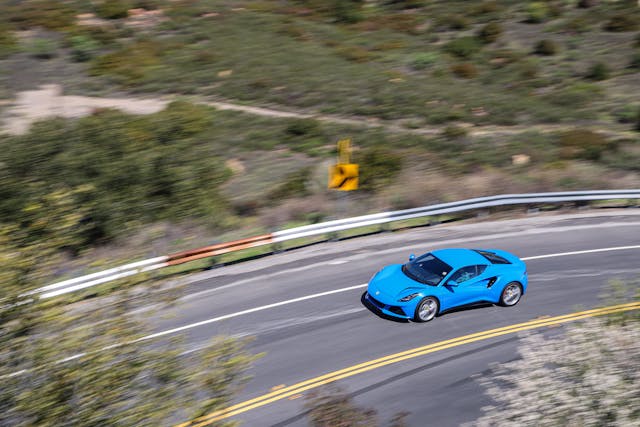
Leaving rhetorical questions behind, the most distinctive aspect of the Emira would be its design, both interior and exterior. While the Evora had been a strikingly attractive and compact vehicle, the introduction of the Emira immediately highlighted how dated the former appeared. Drawing inspiration heavily from Lotus’ flagship hypercar, the electric-powered Evija with its impressive 2000 horsepower output, the Emira manages to stand apart without feeling like a diluted imitation despite being positioned lower in their lineup. Given its approximate cost of around $100k, very few cars can match the allure and boldness displayed by the Emira.

It is quite striking. Two bold character lines cut across the side profile, complemented by an emphatic curved trailing edge and numerous scoops that capture your gaze. Through the rear window, you can glimpse the engine. The front design (as there isn’t a frunk due to the presence of radiators and other cooling system parts) resembles a sleek bulletproof vest sandwiched between predatory headlamps. Opening the doors requires extending what seems like a foot of reach, thanks to door handles seamlessly integrated within the deeply recessed channels designed to channel airflow towards the engine.

The entire design incorporates numerous powerful concave and convex shapes, leading one to believe it would appear ridiculous when viewed from angles not featured in the promotional materials. However, it does not turn out that way. This vehicle has an effect on photographers akin to causing attention deficit—it seems like every new position presents yet another striking perspective that surpasses the previous perfect shot. To put it plainly, this is a stunning automobile that appears superior compared to many high-end supercars costing several times as much.

Continuing into the cockpit, the materials and craftsmanship here should put an end to common quips regarding kitschy car interiors glued together with chewing gum. It truly feels like a high-quality space—one that seems more spacious than expected as well. Over several hundred miles of driving, including navigating through bumpy urban roads, the Emira did not exhibit any usual Lotus rattles or squeals. Like modern standards dictate, physical buttons and dials control climate settings and audio levels inside the cabin, whereas touchscreen interfaces manage most other functionalities. While using the steering wheel, we encountered occasional glitches—its proximity between adjusting volume and navigating menus meant pressing once could trigger multiple actions—but aside from this minor issue, everything else within the vehicle performed smoothly.

Many of these features are managed through a 10.25-inch touchscreen located in the central console, with the remaining information displayed on a 12.3-inch digital instrument cluster positioned in front of the driver. As expected, we were pleased to see support for both Apple CarPlay and Android Auto for smartphone integration. Although purchasing a mid-engine sports car primarily isn't about the audio experience, the 560-watt KEFAudio system proved impressively powerful; however, we found little reason to utilize it much.
The reason being, this engine stands out for delivering exceptional sound quality despite having less than twelve cylinders. It's not solely about the exhaust notes; the V-6 produces a distinctive gurgle and pop at low speeds, evolves into an agreeable roar when you surpass the fuel-efficient range on the tachometer, and as you hit approximately 4-5k RPM, the intake noise takes precedence over the escalating whistle from the supercharger.
Specifications: 2024 Lotus Emira V-6 First Edition
Price: $99,900/$105,930 (base/as-tested)
Powertrain: 3.5-liter DOHC 24-valve supercharged V-6 engine
Output: 400 horsepower at 6,800 revolutions per minute, with 310 pound-feet of torque at 3,500 revolutions per minute.
Layout: two-door, mid-engine rear-wheel-drive hatchback coupe
Weight: 3,270 pounds
0–60 mph: 4.3 seconds (manufacturer claimed)
EPA-rated fuel economy: 19 mpg overall / 16 mpg urban / 24 mpg freeway
Competitors: Porsche Cayman, Chevrolet Corvette
It performs well, feels great, and has excellent sound quality. But how does it handle? If you've read any of the Emira reviews from when the vehicle first came out a couple of years back, you probably already have an idea, but here we go: This is truly a Lotus, and among the most enjoyable everyday sports cars available nowadays. Its hydraulic power-assisted rack-and-pinion steering—which is quite uncommon these days—is remarkably communicative via the steering wheel; only a handful of dedicated Exige enthusiasts might find fault with this feature. Our test model included the "Touring" suspension package designed for greater comfort compared to the sportier "Sport" setting. While it certainly absorbed many bumps smoothly, making rides less jarring, it didn’t leave us craving a stiffer configuration suitable for racing circuits during our time on public roads. Although firm enough to provide engaging feedback, it remains comfortable enough so that daily driving routes aren’t dictated by pavement conditions.

When discussing commutes, this vehicle handles them quite well, even when using the manual functions. While the pedal positions are centralized and the firm pedals are small requiring precise movements, the engine operates smoothly in urban settings. The effort required for shifting gears is justified by the comprehensive control offered by the six-speed transmission. This car provides ample ground clearance, making entry and exit at tilted parking lots relatively stress-free. Additionally, the air conditioning performs excellently, and the audio system is available should you desire one. The sole indication of the robust underpinnings is an intermittent blast of warm air from the front-mounted radiators.

Clearly, the Emira isn't designed to dominate highways or pamper executives with luxury, yet it serves adequately as a day-to-day vehicle, making it suitable for both weekdays and weekends. Inside, you'll find ample cabin storage which includes spots for two cups along with a luggage compartment behind the seat—this replaces the smaller rear seating found in the Evora—and spacious door panels. Despite this, the trunk capacity, at 5.3 cubic feet, can accommodate two suitcases; however, due to high temperatures inside, avoid placing items sensitive to heat back there.
However, you don't purchase a two-door Lotus for cargo space; you buy it for the driving experience, which very few cars can match. The steering feels just right, exactly how you'd wish for in a Lotus—its nimbleness allows effortless maneuvering due to the prominent visibility of the wheel arches through the windshield. Handling at moderate speeds comes naturally, and pushing harder only enhances your enjoyment because the vehicle doesn’t do all the work for you. Sloppy inputs might cause some understeering or oversteering, yet clear warnings precede more challenging situations. This car neither bores nor bites unexpectedly.

The Emira accelerates briskly, making on-ramps enjoyable, yet 400 horsepower might seem modest today. It's commendable that the vehicle didn't chase after exaggerated performance metrics. Paired with the tightly spaced gears of its six-speed transmission, this somewhat restrained output fosters an engaging driving experience without necessitating racetrack sessions or breaking legal speed limits. Regarding control over your velocity, the Emira’s braking system performs well during enthusiastic drives; however, smooth operation demands precise pedal work at low speeds near city intersections and stop signs.
If required to point out minor flaws with the Emira, one might wish for an option to lower the exhaust sound which persists even in the mildest of the three driving modes. Additionally, improving insulation within the trunk could be beneficial, along with adding extra side support to the seating. Lastly, a straightforward start/stop button without the unnecessary fighter-jet-inspired cover would be preferable; as designed, we often had to use our little finger to push underneath this guard rather than lift it properly.
However, these concerns are relatively small when considering how difficult it is to pinpoint significant issues with this vehicle. Given that the Emira signifies the conclusion of an era, expectations were understandably elevated. This model, dubbed "the last true Lotus," naturally attracted considerable attention and criticism. Across every aspect evaluated, the Emira has proven itself as a fitting farewell. Even if our critiques were more substantial, they would likely go unnoticed amidst the roar of the supercharger.
2024 Lotus Emira V- Six First Edition
Highs: It's a sleek, mid-engine Lotus with six speeds that appears stunning and is not overly speedy for an enjoyable experience in everyday driving.
Lows: There is some delay and lack of precision with the infotainment controls, and the trunk storage has limitations beyond just the available space.
Takeaway: If you're looking for a driver's car that isn't a Porsche but still allows you to effortlessly navigate your daily commute and tackle winding roads with equal ease, this is the one.
The post Lotus Operandi: The Emira Marks the Perfect Conclusion to an Epoch appeared first on Hagerty Media .
Interested in buying a car? Discover your perfect match on the MSN Autos Marketplace.