
When siblings grow apart

A considerable amount of disdain has emerged regarding Ducati’s decision to reduce the engine size of their V2 motor from the 955cc Superquadro to an 890cc V2 unit. By eliminating the desmodromic valves, incorporating stronger springs, and supporting everything with a dual-sided swingarm, you have created a formula that even the harshest online critics won’t be able to resist tearing apart. While many of us often repeat the maxim “there’s no substitute for increased capacity,” we recognize that power output isn't the only factor worth considering. In line with this understanding, we turn to another frequently quoted phrase among motorcycle writers: sometimes, a motorcycle conveys a richer narrative beyond what its specifications might suggest.
2025 Ducati Streetfighter V2 S
Ducati’s newest Streetfighter V2 upholds the standard established by the company in Bologna with their other two motorcycles powered by V2 engines: the Panigale V2 for supersports and the Multistrada V2 for sport touring. The bike offers enhanced engine performance across all RPM ranges and a more agile overall design.
Highs
- Strong engine performance across the entire rpm range
- Lighter handling
- Stout, customizable electronics
Sighs
- It appears that the Quickshifter has regressed.
- Pricing will continue to be a source of disagreement compared to the segment.
- There really doesn't need to be three
Since we are now on our, not first , not second However, when reviewing the third Ducati model equipped with the new V2 engine, it’s challenging not to approach it with certain expectations. Having tested the 2025 Streetfighter V2 on various Spanish routes following earlier assessments, the overarching theme remains consistent as Ducati emphasizes handling and frame dynamics rather than pure power output. The Streetfighter draws significantly from the 2025 Panigale V2 configuration previously reviewed.

We can’t expect that you’ve spent the past several months immersed in information about this platform, reading, rewriting, and refining details as much as we have. So, let’s dive right into why the Streetfighter V2 stands out enough to justify your subscription fees.
Chassis that won't quit
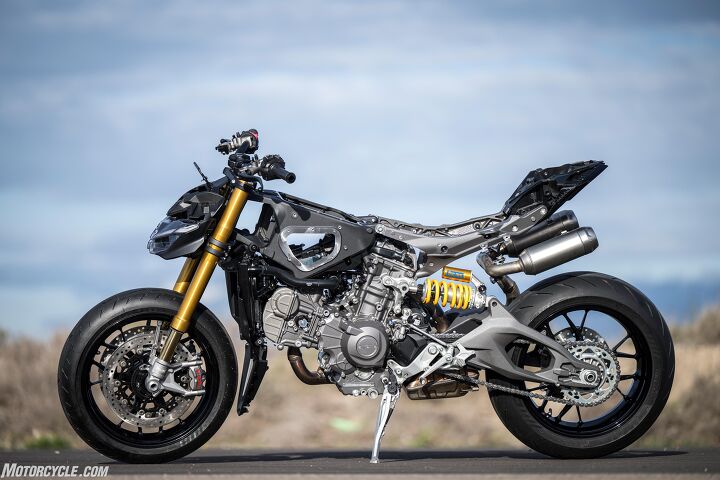
Although the V2 engine defines the essence of the Streetfighter, let’s start our discussion focusing on the Streetfighter V2's chassis performance. Given that integrating the engine as part of the load-bearing structure is now commonplace, and considering Ducati has utilized production-ready monocoque frames since 2012, it can be tempting to underestimate the effort put into turning this practical concept into reality—not merely an academic exercise, but within a high-performance framework.

Similar to what we observed in the even more exposed Street Fighter model, the airbox, subframe, and swingarm form the core structure, largely supported by the V-twin engine. It should be no shock for our audience that engines provide limited flexibility concerning how they transmit chassis feedback, thus highlighting the critical importance of accurately designing these parts. Ducati faces the challenge of balancing rigidity against necessary movement under various stresses—both side-to-side and fore-and-aft—and simultaneously optimizing space usage; for instance, using part of the front section of the frame concurrently as an airbox and steering head area presents additional complexities.

The SF V2 features a cast aluminum subframe along with a swingarm to complete its frame. In comparison to the track-oriented Panigale V2, the Streetfighter has a wheelbase that extends by more than one inch, prioritizing handling stability rather than sheer speed. Similar to its fully-enclosed sibling, it boasts a slightly shallower 24.1-degree rake angle and offers four additional inches of trail length for improved control.
Completing the chassis setup, both the base Streetfighter V2 and the S model come with fully adjustable suspension. The standard version uses components provided by Kayaba, whereas the S model boasts premium offerings from Öhlins. Additionally, both motorcycles include a Sachs steering damper as standard equipment.

During our time testing the Streetfighter V2 S in Spain, we focused primarily on experiencing how Ducati crafted both the engine and handling for this model. While the engine plays an essential role in providing power, what truly stood out was the exceptional control and maneuverability offered by the motorcycle’s design as a whole. One particular moment highlighted the predictability of the bike: during a challenging series of decreasing-radius turns where I activated the front anti-lock braking system (ABS), I remained confident enough to maintain my balance effortlessly—no white-knuckling required. This assurance extended beyond just high-speed curves; even threading the needle between tight switchback corners felt secure due to the vehicle's steady performance. Perhaps unsurprisingly, the finely balanced frame paired with generous lock-to-lock steering capabilities allows riders to navigate urban environments smoothly. Adding to this ease of use, the additional width provided by the 1.2-inch broader handlebars enhances overall versatility and comfort across various riding conditions.

The chassis remains stable during braking too, regardless of whether you’re aggressively applying the brakes or gradually easing off towards the corner. Despite not offering quite the same level of precision as the higher-end Brembo units featured on the V4 model, Ducati has ensured that the Brembo M50 calipers perform exceptionally well. On the flip side, the rear brake requires considerable travel before providing much stopping power. Although the standard configuration with Ohlins parts leans more toward sports performance, Ducati has succeeded in making the Streetfighter V2 an easier bike to handle than previous models—there’s also ample adjustment available for fine-tuning settings.
Clearly, shedding pounds has an impact. According to Ducati, the S version tips the scales at 386 pounds when devoid of fuel, whereas the regular model comes in at 392 pounds. Adding approximately 24 pounds for the four-gallon fuel tank brings the total weights up to 410 pounds for the S variant and 416 pounds for the base model (as a comparison point, the 955cc Streetfighter came in weighing 457 pounds when fully fueled on the MO scales. The weight reduction with the S model is attributed to the use of a lithium-ion battery, changes in passenger amenities, and modifications to the suspension system.

Overall, the Streetfighter V2 handles much more agilely compared to its predecessor, aligning it closer with its middleweight competitors from Austria, Japan, and the UK. The last time we gathered those machines up For a spin around the nearby streets, the Ducati seemed large, cumbersome, and sluggish compared to the other bikes. The 955 Superquadro was the sole redeeming factor elevating its status somewhat, yet even this engine truly showcased its prowess solely during aggressive rides through mountainous terrain or on the racetrack. During regular commuting use within the middle rev range, the motor constantly required careful modulation—whether via throttle control or clutch engagement—to maintain any degree of smooth operation. Additionally, it tended to leave the rider’s posterior rather warm. This brings us neatly into...
The Ducati V2
Just as mentioned earlier, the engine plays an equally vital role in the overall experience of the SF V2 as does the chassis attached to it. This new engine replaces descriptors such as "brutish" with terms like "balanced," and changes from "surging" to "smooth." With a reduction of 65cc compared to the older Superquadro model, this updated version now boasts a slight decrease in bore size down to 96mm and an increase in stroke length up to 61.5mm, resulting in a total displacement of 890cc. Additionally, the engine has been designed to be more compact and weighs about 21 pounds less than its predecessor. Similar to past models, the 90-degree V configuration remains tilted back by 20 degrees for better space utilization and improved weight balance.

Just as previously suggested, Ducati persists in deviating from convention—perhaps just for the sake of doing so—by equipping the newest V-twin engine model with 38.2 mm hollow intake valves paired alongside 30.5 mm exhaust valves operated via conventional finger followers and spring mechanisms. Notably, this valve train design is both lighter and smaller compared to their traditional desmodromic setup—and interestingly enough, maintenance costs such as those incurred during periodic services up until each set’s 18,000-mile mark should be lower too. To address concerns raised earlier about performance across different RPM ranges, Ducati has incorporated an adjustable variable timing mechanism on the intake side which optimizes camshaft timings electronically, ensuring consistent power delivery regardless of your current position within the rev band.

Here’s where the V2 engine truly excels. The previous issues with poor, inconsistent power delivery in the lower and middle RPM ranges have been resolved, replaced instead with seamless throttle control that provides ample torque throughout all revolutions—about 70% of peak torque becomes accessible as early as 3,000 rpm. According to Ducati, this motor delivers 120 horsepower at 10,740 rpm along with 68.8 pound-feet of torque at 8,250 rpm. They assert that the original 955cc V2 generates up to 153 horsepower directly off the crankshaft. Our recent test on a dynamometer showed the Superquadro-equipped Streetfighter V2 achieving around 129.9 horsepower at the back wheel when hitting 10,300 rpm—a figure consistent with approximately 15 percent losses through the drive system before reaching the pavement. Therefore, one can expect the updated V2 model to produce slightly more than 100 horses at the rear wheel.

This serves as an excellent example where the figures fail to provide the complete narrative. Although I concur that typically losing HP sauce isn’t ideal, when control becomes exclusive at maximum output, it leads to an unbalanced experience. Regarding the Streetfighter V2, I wouldn't mind sacrificing peak performance to address the shortcomings in the lower and middle ranges from the earlier model—and this is precisely what Ducati has accomplished.
Torque builds smoothly from low rpm to deliver predictable performance whether you're rocketing between hairpins, or casually surfing the torque curve a gear high between them. Naturally, this experience carries over to riding around town. While we spent little time bouncing between villages, the experience is so night and day compared to the outgoing mill, I can unequivocally say a heartfelt, grazie mille to the engineers in Bologna. As much as I've mentioned the first two thirds of the rpm range, the V2 doesn't fall on its face on the way to its 11,350 rpm redline either. The engine is perfectly happy to extend the thrill upwards of 11,000 with the IVT letting us have our cake and eat it too.
Riding the Matrix
Just like with previous models, the Ducati comes equipped with numerous rider assistance features easily accessible using an updated control panel and a 5-inch TFT screen. Although navigating these options has improved over time, there remains an extensive array of data and customization choices which may require considerable exploration before fully understanding them. These include adjustments for IMU-driven systems such as anti-lock braking (ABS), traction management, wheel lift mitigation, and exhaust braking, along with three distinct power output levels. Additionally, four riding profiles offer pre-set configurations incorporating all mentioned assists; however, each profile allows individual tweaking across multiple variables—almost everything except the front-wheel ABS system can be modified. To summarize the available adjustment possibilities succinctly, refer to the table outlining the different ride modes provided below.
Riding Mode Matrix
Power Mode |
Traction Control |
Wheelie Control |
Quickshift |
ABS Cornering |
Engine Brake Control |
|
RACE |
High 120hp Dynamic RbW |
Level 3 (of 8) |
Level 2 (of 4) |
ON |
Configure maximum performance settings for an amateur rider on the track with cornering adjustments. Disable lift-up detection and enable controlled sliding through brake activation. |
Level 1 (of 3) |
SPORT |
High 120hp Dynamic RbW |
Level 4 (of 8) |
Level 2 (of 4) |
ON |
Setup 3 Road Configuration for Cornering with Sporty/Safety Settings and Moderate Lift-Off Detection |
Level 1 (of 3) |
ROAD |
Medium 120hp Smooth RbW |
Level 5 (of 8) |
Level 3 (of 4) |
ON |
Setup for Road Conditions: Cornering Configuration with Balanced Performance Moderate Lift-Off Detection |
Level 2 (of 3) |
WET |
Low 95hp Smooth RbW |
Level 6 (of 8) |
Level 4 (of 4) |
ON |
Setup for Road Use: Cornering Adjustment - Sporty with Safety Features; Moderate Lift-off Detection |
Level 3 (of 3) |
|
OFF |
OFF |
OFF |
Setup 1: Front only - not suitable for corners Maximum performance for experienced riders on the race track No lift-up detection |
Additional features such as cruise control and Ducati’s Quick Shift 2.0 are included as standard equipment across both models. This updated quickshifter operates using an internal sensor rather than a linkage-based spring mechanism. In my testing on the Multistrada model, I found minimal issues apart from occasional extended shift timings or skipped gears. However, these problems occurred more frequently during recent rides. According to Ducati, this is intended to safeguard the gearbox against harsh handling; however, similar concerns haven’t arisen with earlier Ducatis—or bikes from competing manufacturers who seem to handle the technology well. Interestingly, at a track event held the preceding day featuring the Streetfighter V4—which employs the same system—the problem appeared consistently among all test units. While far from being a decisive flaw, this does appear counterproductive. Nonetheless, improved functionality might just require some future software updates considering past experiences.

A majority of our journey utilized Sport and Race modes, yet we began the day in Road mode. This setup provides access to all 120 horsepower but significantly eases the throttle response, making it ideal for urban driving or highways. However, even with this smoother engagement, I found the transition in Sport mode wasn’t overly harsh during regular operation. When shifted to Race mode, although the power output stays consistent with Sport, traction control becomes less restrictive, and the ABS “2” setting gets unlocked. This feature enables you to execute controlled drifts at the rear while retaining cornering capability. For thrill-seekers ready to embrace greater risk and personal accountability, both traction control and wheelie prevention can be deactivated completely; additionally, ABS settings can be adjusted to Level 1, thereby turning off the cornering function along with the rear ABS system altogether. It’s worth noting that Ducati offers extensive customization options within these riding modes and assistance systems—a degree of flexibility that we believe should become standard across motorcycle manufacturers.

Super-mid, no more
Ducati informs us that switching from the 955cc Superquadro engine used in the original Streetfighter to the new V2 aims to establish a clearer distinction between this model and the Streetfighter V4. Upon testing both motorcycles consecutively, significant differences emerge; however, these disparities were also noticeable when comparing previous models like the Superquadro. Apparently, at dealerships, potential buyers found it challenging to differentiate clearly between them. Therefore, with the introduction of the new Streetfighter V2, Ducati hopes to attract a fresh wave of young enthusiasts into their fold.

Dividing the two models is logical, yet crafting a universally simpler, lighter, and more agile SolusIKAKI.COM that riders can easily utilize represents the real victory. It will be exciting to reunite the segments and observe how everything unfolds this time around.
Scorecard
|
Engine |
19/20 |
Suspension |
15/15 |
Transmission |
8/10 |
|
Brakes |
9/10 |
Instruments |
4/5 |
Ergonomics |
10/10 |
|
Appearance |
9/10 |
Desirability |
9/10 |
Value |
8/10 |
Editors Score: 91.0% |
In Gear

- Helmet: Alpinestars Supertech R10 Carbon Team
- Jacket: Alpinestars Atem V4 (no longer available)
- Pants: Pando Moto Boss Dyn
- Gloves: Alpinestars GP Pro R4
- Boots: Alpinestars Supertech R Vented
|
Specifications |
2025 Ducati Streetfighter V2 |
2025 Ducati Streetfighter V2 S |
|---|---|---|
|
Engine Type |
90° V2 engine design, with 4 valves for each cylinder, includes an adjustable valve timing mechanism for the intake, and uses liquid cooling. |
|
|
Displacement |
890cc |
|
|
Bore x Stroke |
96.0 millimeters by 61.5 millimeters |
|
|
Compression Ratio |
13.1:1 |
|
|
Horsepower |
120 horsepower at 10,750 revolutions per minute (stated) |
|
|
Torque |
69 pound-feet at 8,250 revolutions per minute (stated) |
|
|
Fuel Injection |
Fuel injection system with electronics. Individual injectors for each cylinder. Complete throttle-by-wire functionality. |
|
|
Exhaust |
The 2-1-2 configuration includes one catalytic converter along with three lambda sensors. |
|
|
Gearbox |
6-speed transmission featuring Ducati Quick Shift (DQS) for both upshifts and downshifts version 2.0 |
|
|
Primary Drive |
Helical-cut gears; Gear ratio 1.84:1 |
|
|
Final Drive |
Chain 520; Front sprocket 15; Rear sprocket 42 |
|
|
Clutch |
A hydraulically actuated slipper with a self-servo mechanism for a wet multiple-plate clutch. |
|
|
Frame |
Monocoque aluminum |
|
|
Front Suspension |
Marzocchi 43mm completely adjustable upside-down fork, with 4.7 inches of travel |
Ohlins NIX30 43mm forks featuring TiN coating, completely adjustable inverted design, offering 4.7 inches of travel. |
|
Rear Suspension |
Completely adjustable Kayaba monoshock. The aluminum dual-side swingarm provides 6.3 inches of travel. |
Completely adjustable Öhlins monoshock. The aluminum dual-swingarm provides 6.3 inches of travel. |
|
Front Brake |
2 x 320mm semi-floating discs paired with radially installed Brembo Monobloc M50 piston calipers featuring Bosch Cornering ABS. |
|
|
Rear Brake |
245 mm disc paired with a 2-piston caliper featuring Bosch Cornering ABS |
|
|
Front Wheel |
Y-shaped, 6-spoke light alloy, 3.50" x 17" |
|
|
Rear Wheel |
Y-shaped, 6-spoke light alloy, 5.50" x 17" |
|
|
Front Tire |
Pirelli Diablo Rosso IV 120/70 ZR17 |
|
|
Rear Tire |
Pirelli Diablo Rosso IV 190/55 ZR17 |
|
|
Instrumentation |
Digitally enabled unit featuring a 5-inch TFT color screen with an 800 x 480 pixel resolution. |
|
|
Wet Weight No Fuel |
392 pounds (claimed, no fuel) |
386 pounds (claimed, no fuel) |
|
Seat Height |
33.0 inches |
|
|
Wheelbase |
58.8 inches |
|
|
Rake / Trail |
24.1° / 4.0 inches |
|
|
Fuel Tank Capacity |
4 gallons |
|
|
Number Of Seats |
Dual seat |
Individual seating (a passenger seat kit accessory can be added) |
|
Safety Equipment |
Riding Modes, Power Modes, Bosch Cornering ABS, Ducati Traction Control (DTC), Ducati Wheelie Control (DWC), Engine Brake Control (EBC), Auto tire calibration, Ducati Brake Light (DBL) |
|
|
Standard Equipment |
Ducati Quick Shift (DQS) for both upshifts and downshifts version 2.0, complete LED headlamps featuring daytime running lights (DRL), automatic turn signal shut off, coming home function, passenger seat along with foot pegs, and Sachs steering damper |
Ducati Quick Shift (DQS) for both upshifts and downshifts version 2.0, complete LED headlamps featuring daytime running lights (DRL), automatic turn signal shut-offs, lithium-ion battery, Ducati Power Launch (DPL), pit limiter function, coming home feature, Sachs steering stabilizer, single-seat setup |
|
Warranty |
24 months unlimited mileage |
|
|
Service Intervals |
9,000 miles / 2 years |
|
|
Valve Adjustments |
18,000 miles |
2025 Ducati Streetfighter V2 Review Photo Gallery

Our commitment lies in discovering, investigating, and endorsing top-tier products. Should you choose to buy through our retail links mentioned in the reviews, we receive commissions from those sales. Find out more information regarding how this functions .
Become a solusikaki.com Insider. Be the first to receive the newest solusikaki.com news by subscribing to our newsletter. here .